On November 25, 2025, the second international student conference of the cinEXmedia partnership was held at the Université de Montréal. The event examined methods for studying the cinematic experience in a scientific context.
Léa Tétrault
The second international student conference of cinEXmedia, titled “Studying the Cinematic Experience: Processes, Methods, and Challenges,” took place on November 25, 2025, at the Université de Montréal. Over the course of a full day, more than a dozen participants shared the results of their research on the subjectivity inherent in the cinematic experience and on ways of analyzing it within a scientific framework. Organized by the partnership’s student activities committee, the event once again proved highly successful.
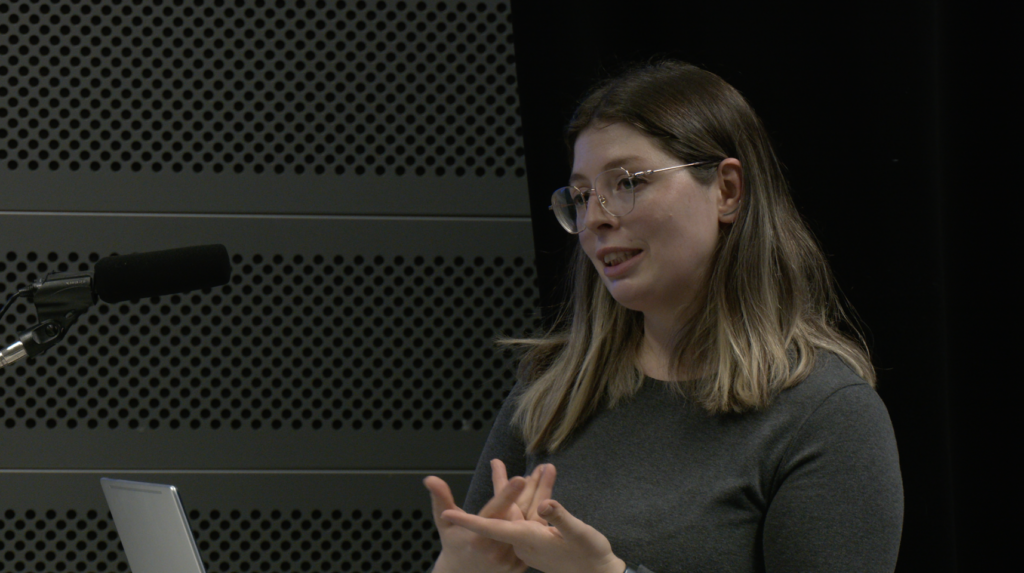
“The goal of this second edition was to better understand, in concrete terms, which scientific methods can account for the lived experience of people watching audiovisual content,” explains Maude Sills-Néron, head of the committee. She also delivered the event’s opening remarks.
However, the cinematic experience was also approached “more broadly,” Sills-Néron notes, in order to examine “the study of audiovisual media and their reception, as well as the methodological challenges they entail. Not only because reception is inherently subjective,” she continues, “but also because these objects of study are multiple: they engage several senses, involve different cognitive loads, and are consumed across a wide range of devices, in varied contexts that are not necessarily laboratory settings, for example. So how can we produce knowledge about these experiences without distorting them, without sanitizing them?”
Elen Lotman, filmmaker, researcher, and professor at Tallinn University in Estonia, delivered the keynote lecture titled “Film in Mind: Towards Understanding Experiential Heuristics of Professional Filmmaking.” She presented her recent work demonstrating how filmmakers can make creative decisions not only based on theoretical rules, but also through cognitive processes stemming from the mental representation of their project in advance. “The screen constitutes a very rich and relevant field of study for understanding how the human mind works,” she stated.
Rather than proposing a definitive model for understanding film reception, the filmmaker put forward hypotheses on ways of studying films in order to better grasp how they may emerge from subjective mental representations. Her presentation nonetheless helped open up reflection on the elements that shape our perception of films and on the details that deserve closer attention.
cinEXmedia, Engaged with Its Community
In the subsequent sessions of the conference, around ten students—including three doctoral candidates in research-creation at the Université de Montréal, Julien Bouthillier, Chedly Boughedir, and Mehdi Bouzoubâa—shared their reflections on related topics. The subjects ranged from extreme horror cinema to autoethnography, spanning various disciplines such as television studies and cultural studies. The conference thus aligned with “the partnership’s intersectoral approach,” Sills-Néron emphasizes.
Another goal of the event was to allow participants to build connections. “We are not always inclined to look at what researchers are doing in other universities, but that is actually what helps advance one’s research, assess one’s approach, and broaden one’s horizons,” the organizer explains.
Committed to this goal and to showcasing the research of students within the cinEXmedia community, she also expressed openness to external proposals: “The student affairs committee has made itself visible on the partnership’s website by providing our email addresses, so that anyone can write to us, propose ideas, and help improve our work.”