
Professor at the Faculty of Music at the Université de Montréal, the researcher—specializing in musicology, lyric diction, and research-creation methodologies—has now joined the partnership to explore new methods of data collection through music.
Léa Tétrault
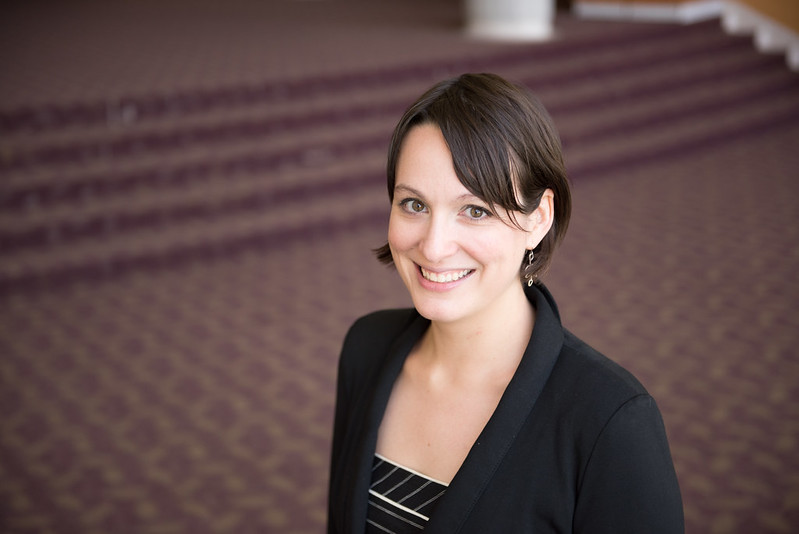
Lecturer at the Université de Montréal since 2015, Zoey Mariniello Cochran has recently become an invited professor at the Faculty of Music. Passionate about teaching—a vocation recognized by her receiving the Université de Montréal’s Teaching Excellence Award in 2018—she now offers a range of courses on opera and lyric diction at both undergraduate and graduate levels within the same institution.
The researcher also joined cinEXmedia this year as a co-investigator, at the invitation of the partnership’s director, Santiago Hidalgo. In particular, she aims to develop an innovative research-creation project with the partnership. This project will explore musical co-creation as an alternative method of data collection in clinical contexts, for instance as a replacement for surveys documenting artists’ lived experiences. More details about this project will be revealed later, as its timeline and funding structure remain to be confirmed.
“In a context where research-creation and intersectorality are increasingly valued, the project with cinEXmedia would aim to design duo-based creative workshops that provide access to otherwise inaccessible forms of knowledge,” explains Zoey Mariniello Cochran. “I’m very eager to see where this might lead.”
Identity, politics, and the study of rhythm
A specialist in both Baroque and contemporary opera, Zoey Mariniello Cochran has, in recent years, focused her research on the relationship between vocality, identity, and politics, on the representation of gender identities on the operatic stage, and on the decolonization of opera as a genre. Her work on opera as a tool of resistance in the Viceroyalty of Naples, presented at numerous conferences, earned her the George Proctor Prize awarded by the Canadian University Music Society (MusCan). She also collaborates with the Laboratoire CinéMédias as part of the Killam initiative, a large-scale intersectoral project exploring different approaches to the study of rhythm.
She recently received a Social Sciences and Humanities Research Council of Canada (SSHRC) Insight Development Grant for a project that uses singing as a method of musicological analysis. “I wanted to observe how a vocal interpretation that takes into account the prosodic accentuation of verse transforms our understanding of text–music relationships,” she explains. This research is based on various case studies across centuries, including The Marriage of Figaro by Mozart.
The young professor is also a co-investigator with the Canada Research Chair in Opera Creation. In this capacity, she collaborated with a multidisciplinary team of researchers based at the Université de Montréal—Ana Sokolović (music), Olivier Asselin (cinema), and Marie-Josèphe Vallée (urban planning)—on a first major project titled OpéRA de poche. This initiative notably enabled them “to develop augmented reality operas available on tablets and smartphones, in order to make opera accessible to new audiences,” she notes.
Clowns in music
Together with Ana Sokolović and Tara Karmous, senior coordinator of the Laboratoire CinéMédias and assistant to the Canada Research Chair in Film and Media Studies, Zoey Mariniello Cochran recently organized an international conference at Place des Arts in Montréal on clowning, particularly its connections to opera. Entitled Subverting Sonic Conventions: The Languages and Non-Languages of Clowns, the event took place alongside performances of the opera Clown(s) at the Opéra de Montréal, a work by Ana Sokolović.
Ana Sokolović and Zoey Mariniello Cochran also recently received a SSHRC Partnership Engage Grant with the sound mime duo ék to create improvisation workshops centered on clowns and opera. Presented in primary and secondary schools, these workshops are created to help young people develop awareness of their bodies and emotions while transforming traditional approaches to opera.
New interactive scores
Finally, Zoey Mariniello Cochran is working with researcher François-Hugues Leclair on a newly funded project through the SSHRC Connection program to develop what she calls “new interactive scores.” “A score only provides pitch and note duration, but there is so much more information that could be added through digital formats,” she explains. The goal of the project is to create a type of score that incorporates elements of musical analysis in order to examine how this influences a musician’s interpretation. This research, centered on the opera Wozzeck by Alban Berg, will be conducted in collaboration with partners in South America, from a decolonial perspective.
Zoey Mariniello Cochran’s recent association with cinEXmedia is thus part of a broader body of work that reflects the diversity of her research. Her career illustrates how the study of opera can be renewed in academic contexts today, particularly through research-creation and the use of technological tools.